Sign in

Code editor

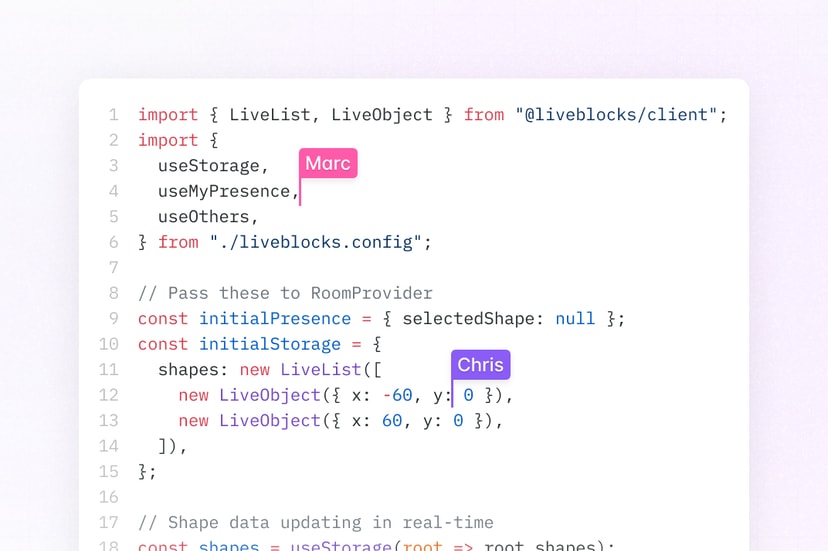
Create a collaborative code editor with Liveblocks. Synchronize code between users with character-level precision, show remote carets and selections, edit files with AI, and restore previous versions.
Code editor demo blog

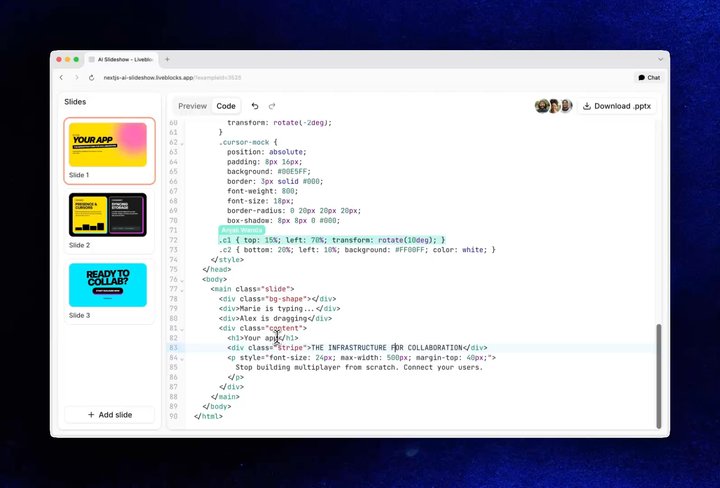
Code editing in the AI Slideshow example

Features

  • Realtime collaboration: The code file is permanent and updates in realtime for connected users.
  • Presence: Show remote carets, selections, avatar stacks, and agent activity.
  • Server-side editing: Modify documents from your back end, and watch them update in realtime.
  • Agentic editing: Generate and apply code changes with AI agents.
  • Version history: Save, preview, and restore file versions using manual or automatic snapshots.
  • Multiplayer undo/redo: Each user can independently undo and redo their own changes.
  • Comments: Attach review discussions to the code.
  • Permissions: Control which users can read and edit the file.

Get started

Choose a starting point for your code editor.

Implementation

This is an overview of how each feature can be implemented using the @liveblocks/codemirror package. Code files are stored in Sync and live selections are broadcast using Presence.

Realtime collaboration

Using createLiveblocksSyncPlugin, you can set up a CodeMirror editor that stores your code as a LiveText using Sync. Local edits are written to Sync, remote edits are applied to the editor, and concurrent changes are merged character-by-character.

"use client";
import { useEffect, useRef } from "react";import { EditorView } from "@codemirror/view";import { EditorState } from "@codemirror/state";import type { LiveText } from "@liveblocks/client";import { createLiveblocksSyncPlugin, createLiveblocksPresencePlugin,} from "@liveblocks/codemirror";import { useRoom } from "@liveblocks/react/suspense";
function CodeEditor({ text }: { text: LiveText }) { const room = useRoom(); const containerRef = useRef<HTMLDivElement>(null);
useEffect(() => { if (containerRef.current === null) return;
const view = new EditorView({ parent: containerRef.current, state: EditorState.create({ doc: text.toString(), extensions: [ createLiveblocksSyncPlugin(room, text), createLiveblocksPresencePlugin(room, text), ], }), });
return () => { view.destroy(); }; }, [room, text]);
return <div ref={containerRef} />;}

Multiple code files can be stored in a single room by passing different LiveText values. Learn more under Sync integrations and Storage.

Presence

Broadcast each user’s caret and selection with createLiveblocksPresencePlugin. Remote carets are colored with each user’s info.color, and positions stay stable across concurrent edits.

"use client";
import { useEffect, useRef } from "react";import { EditorView } from "@codemirror/view";import { EditorState } from "@codemirror/state";import type { LiveText } from "@liveblocks/client";import { createLiveblocksSyncPlugin, createLiveblocksPresencePlugin,} from "@liveblocks/codemirror";import { useRoom } from "@liveblocks/react/suspense";
function CodeEditor({ text }: { text: LiveText }) { const room = useRoom(); const containerRef = useRef<HTMLDivElement>(null);
useEffect(() => { if (containerRef.current === null) return;
const view = new EditorView({ parent: containerRef.current, state: EditorState.create({ doc: text.toString(), extensions: [ createLiveblocksSyncPlugin(room, text), createLiveblocksPresencePlugin(room, text), ], }), });
return () => { view.destroy(); }; }, [room, text]);
return <div ref={containerRef} />;}

To show who’s currently in the file, add the ready-made AvatarStack component, or build custom presence UI with useOthers. Learn more under Presence.

Server-side editing

Trusted server processes can edit the code with Liveblocks.mutateStorage, using the same LiveText API as the client. The mutation targets the exact document the editor syncs with, and connected users see the change in realtime.

import { Liveblocks } from "@liveblocks/node";
const liveblocks = new Liveblocks({ secret: process.env.LIVEBLOCKS_SECRET_KEY!,});
await liveblocks.mutateStorage("my-room", ({ root }) => { const document = root.get("document"); document.insert(document.length, "\n// TODO: add tests");});

Learn more under Server-side editing.

Agentic editing

To allow AI agents to modify your code, generate your changes with AI then use mutateStorage to apply them. To show that AI is working in your app use setPresence to show it working—your agent will appear in Presence alongside humans. Finally, remove the agent’s presence to indicate that the agent is no longer working.

import { Liveblocks } from "@liveblocks/node";import { generateText, Output } from "ai";import { z } from "zod";
const liveblocks = new Liveblocks({ secret: process.env.LIVEBLOCKS_SECRET_KEY!,});
const roomId = "code-room";const agent: Liveblocks["UserMeta"] = { id: "ai-agent", info: { name: "AI agent", color: "#7c3aed" },};
await liveblocks.setPresence(roomId, { userId: agent.id, userInfo: agent.info, data: { status: "thinking" }, ttl: 60,});
await liveblocks.mutateStorage(roomId, async ({ root }) => { const text = root.get("document");
const { output } = await generateText({ model: "openai/gpt-5.6-sol", output: Output.object({ schema: z.object({ code: z.string(), }), }), prompt: `Write a unit test for the file. Here is the current file: ${text.toJSON()}`, });
text.insert(text.length, `\n${output.code}`);});
await liveblocks.setPresence(roomId, { userId: agent.id, userInfo: agent.info, data: { status: "idle" }, ttl: 2,});

Additionally, you can use Feeds to store AI workflow state, and to pass agent status updates to the UI. Learn more under Agentic editing.

Version history

Create version snapshots before major changes, such as agentic edits, then preview and restore them. Use useHistoryVersions to list versions, useHistoryVersionStorageData to build a read-only preview, and useRestoreToStorageVersion to restore the complete file as one synchronized change.

import { useRestoreToStorageVersion } from "@liveblocks/react/suspense";
function RestoreFile({ versionId }: { versionId: string }) { const restore = useRestoreToStorageVersion(versionId);
return <button onClick={() => restore()}>Restore this version</button>;}

Automatic versions can be enabled in the dashboard, and meaningful versions can be created from a backend with Liveblocks.createVersionHistorySnapshot. Learn more under Version history.

Multiplayer undo/redo

createLiveblocksSyncPlugin wires the editor’s standard keyboard shortcuts, such as Mod-z and Mod-y, to the room’s history, so each user can independently undo and redo their own changes. Connect the same history to custom buttons with useUndo, useRedo, useCanUndo, and useCanRedo.

import {  useCanRedo,  useCanUndo,  useRedo,  useUndo,} from "@liveblocks/react/suspense";
function CodeEditorToolbar() { const undo = useUndo(); const redo = useRedo(); const canUndo = useCanUndo(); const canRedo = useCanRedo();
return ( <> <button onClick={undo} disabled={!canUndo}> Undo </button> <button onClick={redo} disabled={!canRedo}> Redo </button> </> );}

Learn more under Multiplayer undo/redo.

Comments

Add review discussions with Comments by attaching a line number to each thread’s metadata. Create threads with the ready-made Composer component, then list them beside the editor with useThreads and Thread.

import { useThreads } from "@liveblocks/react/suspense";import { Thread } from "@liveblocks/react-ui";
function CodeReviewThreads() { const { threads } = useThreads({ query: { resolved: false } });
return ( <aside> {threads.map((thread) => ( <div key={thread.id}> <span>Line {thread.metadata.line}</span> <Thread thread={thread} /> </div> ))} </aside> );}

Learn more under Comments.

Permissions

Each code file is contained inside a room in your Liveblocks app, and permission groups can set access to the file. For example, your file may have an editor group and a viewer group. This can be set when modifying or creating a room, for example with Liveblocks.createRoom.

await liveblocks.createRoom(`my-room-id`, {  defaultAccesses: [    // No access by default  ],  groupsAccesses: {    // "viewers" group has read access    viewers: ["*:read"],  },  usersAccesses: {    // "olivier" has write access    olivier: ["*:write"],  },});

More complex controls can be set too, learn more under Permissions.

Examples

Explore complete implementations in our example gallery.